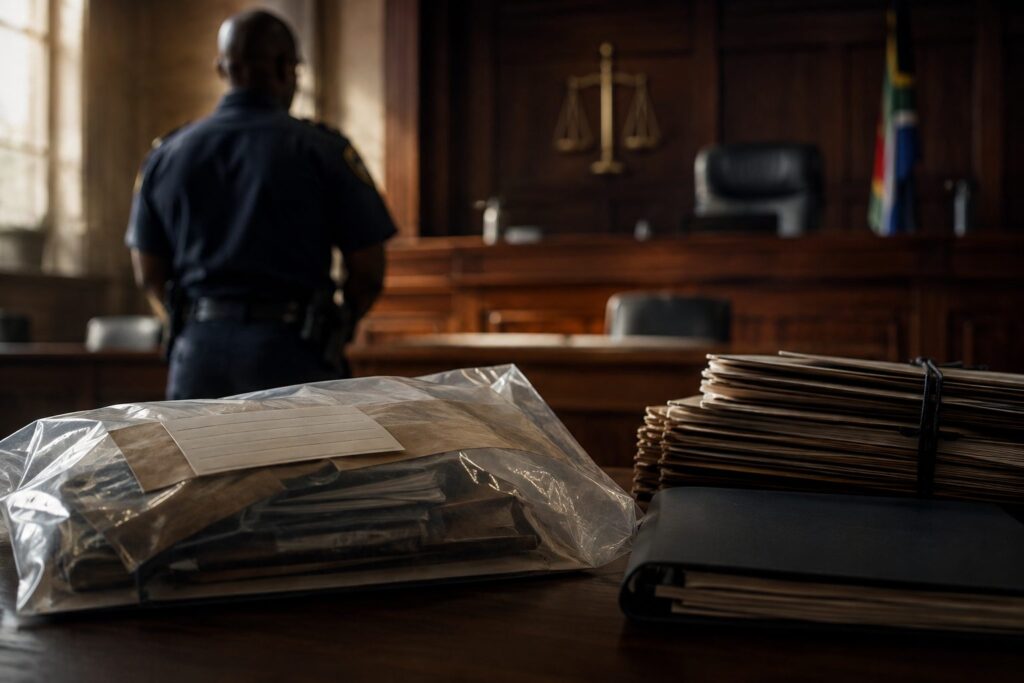
The Madlanga Commission and the Integrity of Criminal Investigations
The Madlanga Commission of Inquiry has become one of the most significant public examinations of South Africa’s criminal justice system in recent years.
The Commission was established to investigate allegations of criminality, political interference and corruption within the criminal justice system following allegations made by KwaZulu-Natal Provincial Commissioner Lieutenant-General Nhlanhla Mkhwanazi in July 2025. It is chaired by retired Constitutional Court Justice Mbuyiseli Madlanga.
The Commission’s hearings have attracted considerable public attention because they concern not only individual allegations of wrongdoing, but also the integrity of the institutions responsible for investigating crime, preserving evidence and bringing accused persons before court.
The final report was initially expected in August 2026. The reporting deadline has since been extended to 16 November 2026, with evidence expected to conclude by 2 October 2026. The Presidency explained that the extension was necessary to allow the Commission to complete the subjects arising from the hearings.
The Commission’s proceedings are important. They are not, however, a substitute for a criminal trial. Evidence given before a commission does not automatically prove that a particular police officer acted improperly in a separate criminal case. Nor does evidence of institutional dysfunction mean that every investigation conducted by the South African Police Service is unreliable.
The proper legal question is narrower and more disciplined:
Does the evidence in the particular criminal case remain reliable, admissible and sufficient to prove the accused’s guilt beyond a reasonable doubt?
That question must be answered from the actual docket, witnesses, exhibits, forensic records and investigative history in the case concerned.
A commission of inquiry does not decide criminal guilt
A commission of inquiry is primarily an investigative and fact-finding body. It may expose systemic failures, identify misconduct, recommend disciplinary action and refer suspected criminal conduct to the relevant authorities.
It does not ordinarily convict or acquit individuals.
The Presidency has stated that the Madlanga Commission’s interim reports referred certain matters for criminal investigation, prosecutorial consideration and employment-related action. A second interim report was delivered to the President in May 2026 while the Commission’s work continued.
This distinction matters because public allegations, media reporting and commission testimony cannot simply be introduced into an unrelated criminal trial as proof that an investigating officer is dishonest.
A court must assess admissible evidence. An accused person who seeks to rely on evidence emerging from the Commission must ordinarily show that it has a legitimate and material connection to the investigation or prosecution of that accused.
The connection may arise where, for example:
The same officer investigated the accused’s matter.
The same specialised unit handled the case.
The same forensic process or evidence-management system was used.
The Commission evidence concerns the manipulation, suppression or fabrication of evidence of the kind relied upon in the accused’s case.
The officer’s evidence at the Commission contradicts a statement or testimony given in the criminal proceedings.
The officer’s credibility, independence or relationship with another witness is directly relevant to the case.
Without such a link, general allegations of police corruption may have significant public importance but limited evidential value in an individual trial.
Police evidence is not accepted merely because it comes from the police
Police officers are witnesses like any other witnesses. Their evidence must be evaluated for credibility, reliability, consistency and probability.
A police officer’s official position does not create a presumption that the officer’s evidence is correct. Equally, allegations of corruption elsewhere in the police service do not create a presumption that every officer is dishonest.
The court must examine the evidence as a whole.
This includes whether the officer’s testimony is consistent with contemporaneous records, photographs, electronic data, forensic results, witness statements and objective probabilities.
It also requires attention to whether the officer can adequately explain:
When and how an exhibit was found.
Who first handled the exhibit.
How it was marked and sealed.
Where it was stored.
Who transported it.
Whether the seal remained intact.
Who received it at the forensic laboratory.
How the result was linked back to the correct exhibit and accused.
These are not peripheral matters. They form part of the evidential foundation required to prove that the object tested or analysed is the same object allegedly recovered during the investigation.
Why chain of custody matters
The chain of custody is the documented history of an exhibit from the time it is recovered until it is presented in court.
It is particularly important in cases involving DNA, firearms, ammunition, drugs, blood samples, fingerprints, electronic devices and other forensic material.
A break in the chain of custody does not automatically make evidence inadmissible. The significance of the break depends on the nature of the evidence, the extent of the irregularity and whether the State can still prove the exhibit’s identity and integrity.
The defence must therefore avoid treating every administrative omission as fatal. The proper inquiry is whether the State has established, beyond reasonable doubt, that the evidence was not substituted, contaminated, altered or incorrectly attributed.
Recent South African litigation continues to demonstrate that the handling and identification of exhibits remain legally significant. In Maphosa and Others v S, chain-of-custody compliance was expressly raised in relation to the statutory requirements governing the delivery and identification of exhibits.
Where the Madlanga Commission reveals failures in evidence handling, docket management or investigative oversight, the defence must determine whether those failures are replicated in the accused’s case.
The focus should remain case-specific.
Disclosure of the police docket is central to a fair trial
An accused person cannot properly challenge the State’s case without access to the evidence on which the prosecution intends to rely.
Section 35(3) of the Constitution protects the right of every accused person to a fair trial. This includes the right to be informed of the charge with sufficient detail, to have adequate time and facilities to prepare a defence, to be presumed innocent, and to adduce and challenge evidence.
The Constitutional Court addressed disclosure in Shabalala and Others v Attorney-General of the Transvaal and Another. The Court rejected the old concept of blanket docket privilege and held that an accused person should ordinarily have access to witness statements and material that is exculpatory or prima facie likely to assist the defence.
That principle extends beyond the charge sheet.
The defence may require access to:
Witness statements.
Expert reports.
Photographic evidence.
Video footage.
Identification-parade documentation.
DNA reports.
Ballistic reports.
Cellphone records.
Extraction reports.
Scene photographs.
Evidence registers.
Laboratory submission forms.
Occurrence-book entries.
Investigative correspondence.
Relevant portions of the investigation diary.
In May 2026, the Western Cape High Court reaffirmed that disclosure commonly includes forensic and documentary material such as cellphone, DNA and ballistic analyses, post-mortem reports, forensic audits, identification-parade documents, photographs and video material. The Court recognised that an accused may be unable to challenge the State’s evidence effectively without prior disclosure of such material.
Where questions have arisen about the integrity of an investigation, the defence may need more than the statements the prosecutor intends to use.
The defence may also require documents showing how the investigation unfolded, who made particular decisions and whether potentially exculpatory avenues were ignored.
Sections B and C of the police docket
A police docket ordinarily contains three broad sections.
Section A generally includes witness statements, expert reports and documentary exhibits.
Section B generally contains internal reports and memoranda.
Section C generally contains the investigation diary and chronological history of the investigation.
The defence is not automatically entitled to every document in sections B and C. However, the State cannot withhold material merely by describing it as internal or privileged.
In Wolf v S, the High Court confirmed that an accused may be entitled to documents beyond witness statements and exhibits where those documents are relevant to the exercise of the fair-trial right and may assist the accused in adducing and challenging evidence.
In Mkhize and Others v S, the Gauteng High Court again emphasised that disclosure must be tailored to what is relevant to a fair trial. The accused does not enjoy an unlimited right to every item held by the State, but a blanket refusal remains constitutionally impermissible.
This balance is important.
A defence request should identify the category of material sought, explain its relevance and connect it to a disputed issue in the case.
A speculative demand for the entire docket is less likely to succeed than a focused request directed at identifiable investigative irregularities.
What the defence should investigate
Where police officers or units connected to a criminal matter have been implicated in public hearings, the defence should conduct a structured investigation.
The first step is to identify every officer who played a material role in the case. This includes the investigating officer, arresting officers, scene personnel, exhibit officers, intelligence officers and members responsible for electronic or forensic evidence.
The second step is to identify whether any of those persons have appeared before, been referred to, or been implicated in the Madlanga Commission.
The third step is to determine whether the Commission evidence relates to the same period, unit, operation, investigation, informant or alleged criminal network.
The fourth step is to compare the criminal docket with the Commission evidence.
That comparison should address:
Whether the officer gave inconsistent accounts.
Whether the officer failed to disclose a relationship or conflict of interest.
Whether exhibits were handled outside prescribed procedures.
Whether information was introduced into the docket without a verifiable source.
Whether relevant evidence was omitted, lost or suppressed.
Whether the investigation was redirected for an improper purpose.
Whether the accused was selected on the basis of unreliable intelligence.
Whether witnesses were influenced or statements were improperly obtained.
Whether the officer’s role was greater or different from what appears in the docket.
The fact that an officer has been mentioned at the Commission does not itself prove misconduct. The evidential value lies in the details and their demonstrable connection to the accused’s case.
The duty to preserve both incriminating and exculpatory evidence
A criminal investigation should not be conducted merely to assemble evidence supporting a predetermined theory.
Investigators are required to follow relevant evidence, preserve exhibits and place material facts before the prosecution. Prosecutors are expected to act fairly and not suppress material that may assist the defence.
In Shabalala, the Constitutional Court confirmed that documents that are exculpatory or prima facie likely to help the defence should ordinarily be disclosed.
This principle becomes particularly important where the integrity of the investigative process is questioned.
The defence should ask:
Were alternative suspects investigated?
Were alibi witnesses interviewed?
Were statements that contradicted the State’s theory retained?
Were earlier versions of witness statements disclosed?
Were all photographs and videos preserved?
Were negative forensic results disclosed?
Were unsuccessful identification procedures recorded?
Were potentially exculpatory cellphone records obtained?
Were informant allegations independently verified?
A fair investigation is not measured only by what was collected. It must also be assessed by what was ignored, lost or withheld.
Cellphone evidence requires proper authentication
Modern serious-crime prosecutions frequently rely on cellphone records, location information, extracted messages and communication patterns.
This evidence can be highly probative. It can also be misunderstood or overstated.
Cellphone evidence may prove that a particular device connected to a particular tower or exchanged data at a particular time. It does not necessarily prove who was personally holding the device, who authored a message or why a communication occurred.
The reliability of the evidence depends on proper collection, extraction, preservation, authentication and interpretation.
In Mohapi v S, the Gauteng High Court upheld the use of cellphone records where the reliability and authenticity of the records had been established through competent testimony and where the records formed part of a broader body of circumstantial evidence.
The decision illustrates an important defence principle: cellphone evidence cannot be dismissed merely because it is electronic, but it also cannot be accepted without examining its source, integrity and evidential meaning.
The defence should obtain the underlying records, not merely a police summary or presentation.
The standard remains proof beyond reasonable doubt
Public concern about organised crime, corruption and police infiltration does not reduce the burden resting on the State.
Every accused person remains presumed innocent.
The State must prove guilt beyond a reasonable doubt through admissible and reliable evidence.
A court may strongly suspect that an accused is involved in criminal conduct, but suspicion is not enough. Recent South African appellate decisions continue to reaffirm that the high standard of proof is a fundamental component of the fair-trial right and that an accused must be acquitted where reasonable doubt remains.
The defence is not required to prove that every police witness is corrupt.
It is sufficient to demonstrate that the State’s evidence, viewed as a whole, is not reliable enough to support a safe conviction.
That may arise from contradictions, broken chains of custody, missing records, improper identification procedures, unexplained alterations, unreliable intelligence, contaminated exhibits or the absence of independent corroboration.
What the Madlanga Commission does not mean
The Commission’s work should not be misused.
It does not mean that all police officers are dishonest.
It does not mean that every investigation is compromised.
It does not mean that every accused person is entitled to an acquittal.
It does not mean that a court may disregard otherwise reliable evidence.
It does not permit the defence to rely on political commentary or media reports in place of admissible evidence.
The Commission’s value to criminal litigation lies in its potential to identify specific witnesses, practices, relationships and institutional failures that may require closer examination in individual cases.
Its relevance must always be proved rather than assumed.
What accused persons and their legal representatives should do now
Where a serious criminal case involves specialised police units, intelligence structures, forensic evidence or officers mentioned in the Madlanga Commission, the docket should be reconsidered carefully.
The defence should not wait until the closing stages of the trial.
A proper review should include:
A complete officer and witness register.
A chronology of the investigation.
A docket-disclosure audit.
An exhibit and chain-of-custody schedule.
A comparison of witness statements and oral evidence.
A list of outstanding forensic source documents.
An assessment of whether Commission material is relevant and admissible.
A focused request for further disclosure where necessary.
A cross-examination plan directed at the specific irregularities identified.
The objective is not to convert the criminal trial into an inquiry into the entire police service.
The objective is to determine whether the State can prove the particular case against the particular accused through evidence that remains reliable after proper scrutiny.
Conclusion
The Madlanga Commission has placed the integrity of South Africa’s criminal justice system under unprecedented public examination.
Its work may contribute to institutional reform, criminal investigations and disciplinary action. It may also provide important information relevant to pending criminal cases.
However, the legal consequences must be assessed case by case.
An accused person does not obtain an acquittal merely because corruption exists within law-enforcement structures. By the same measure, a court cannot ignore credible evidence that a particular investigation was manipulated, compromised or conducted in breach of fair-trial protections.
The decisive questions remain whether the evidence was lawfully obtained, properly preserved, fully disclosed, reliably presented and sufficient to prove guilt beyond a reasonable doubt.
Consultation
Where a criminal matter involves police officers, units or investigative procedures arising from the Madlanga Commission, the defence should conduct a focused review of the docket, witness evidence and forensic chain before deciding how the material should be used.
Consultation requests may be submitted through advocatemichelleives.co.za.
Disclaimer
This article provides general information on South African criminal law and procedure. It does not constitute legal advice in respect of any particular matter. The relevance of evidence from a commission of inquiry depends on the facts, the applicable law, the admissibility of the material and its connection to the criminal proceedings concerned.